


According to recent data, too many of us are again blindly following technology’s directives, this time flying over legal cliff edges into criminal prosecution!
What am I talking about? Our unguarded, over-reliance on AI – especially in legal matters.
This months’ Newsletter explains WHAT’s going wrong, WHY it’s going wrong,
HOW to correct it, and finally a legal WATCH OUT!
Surrounded by cliff edges
More and more people are prompting AI for legal advice and then blindly accepting the AI-generated ‘advice’ as fact. These elaborately worded AI-written documents, citing legal precedents and smart-sounding judgements, are then submitted to the courts.
The problem is, in some cases the AI advice is incorrect, and the cited judgements simply don’t exist or don’t apply. They are AI hallucinations or ‘ghost references’. Having submitted this into evidence, these litigants are now on the wrong side of the law, and ‘AI told me to do it’ is not defence strategy… yet!
Trained lawyers and clients alike have fallen into this AI-generated trap.
Here are some real-life examples of what AI wrongly ‘advised’ people to do – cases which we at bowers.law have been involved.
- Submit illegally obtained documents into evidence in civil court proceedings (emails from someone else’s email accounts stored on someone else’s devices). This breaches several IT-related criminal laws.
- Include ‘ghost’ or ‘hallucinated’ case authorities in written submissions in Hong Kong court proceedings. This might be an ‘honest’ mistake, but it is considered misleading the court at best and in contempt of court at worst.
- Make blackmail threats. Even if a debt is legitimately owed, the law strictly prohibits the use of unlawful threats, intimidation, or fear to enforce payment. ‘Demanding money with menaces’ in correspondence is in breach of the Theft Ordinance and other related Hong Kong Ordinances.
- Doxx adversaries online / harassing and stalking opponents (online and in person). This breaches various personal data and other criminal laws. (See October 2026 Newsletter)
- Transfer misappropriated funds to family, friends and other associates in an attempt to circumvent personal liability. This actually transfers the liability to the recipients of the funds and exposes them to prosecution for various financial crimes.
So why doesn’t AI know the difference between
what’s legal and what’s illegal in Hong Kong?
Lost in Translation
Global AI models hallucinate Hong Kong legal landscape
According to the 2024 Stanford RegLab study1 the hallucination rates for general purpose LLMs ranged from 69% to 88% in response to specific legal queries. As bad as these figures are, they only relate to US-jurisdictions.
When using these same tools and asking about relevant laws for Hong Kong the error rates are significantly higher. Which is why we are receiving increasing instructions from clients (from Gemini or Claude etc) which can range from nonsensical to illegal!
The same is true of legal-specific AI tools. If your legal jurisprudence is the US, then hallucinations drop to 17% to 35%. Shift the focus of your enquiry to Hong Kong, and again the margin of error becomes much higher.
This is because Hong Kong is highly difficult for AI models to accurately navigate.
Let’s take a look at why this is:
- Data Asymmetry (US vs. HK)
All AI tools are trained on existing legal databases, and this is where the problem begins. In order to accurately predict the ‘next word’, LLMs require vast oceans of linguistic patterns to draw from.
The US database consists of hundreds of years of data spanning 50 states, thousands of federal courts, millions of heavily digitized, open-access opinions, and a massive ecosystem of commercial legal writing.
The Hong Kong Database: By comparison, Hong Kong’s case law footprint is a tiny pond. This severe lack of local text data means AI models struggle to maintain contextual grounding, and when this happens, they default to ‘guessing’ or ‘hallucinating’.
- The Common Law ‘Cross-Pollination’ Trap
Hong Kong operates as a common law jurisdiction under the principle of stare decisis (binding precedent). Crucially, under Article 84 of the Basic Law, Hong Kong courts are explicitly permitted to refer to precedents from other common law jurisdictions (UK, Australia, New Zealand, Canada) for persuasive authority. This is a nightmare scenario for AI.
To an algorithm, a foreign authority cited for persuasion looks identical to binding local law, so it might enthusiastically blend jurisprudence and hand you a perfectly logical legal argument that happens to be entirely non-existent in Hong Kong.
- Bilingual Statutory Discrepancies
Hong Kong has a unique, strictly bilingual legal system. Ordinances are enacted in both English and Traditional Chinese.2 Both texts are equally authentic and carry identical legal weight.
LLMs frequently exhibit performance collapse, when trying to map nuanced legal concepts between English and Chinese legal language and frameworks.
Found in Hong Kong
How to follow the right legal map
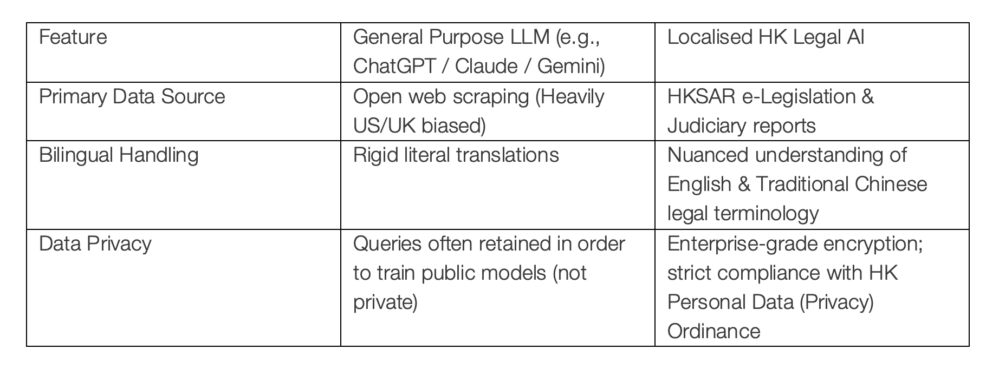
In response to this, several localized legal AI platforms have emerged specifically tailored to the Hong Kong jurisdiction, reducing hallucination rates significantly. Ask.Legal claims 3% or less for its platform (not independently verified). Either way, this is good news for HK lawyers.
These HK-trained systems achieve this by hard-grounding their retrieval mechanisms into localized HKSAR Ordinances, Department of Justice (DoJ) e-Legislation data, and Judiciary case law. They also overcome terminology issues and data privacy – more on that later.
Localized Architecture vs. General AI
Prompt prompt prompt
It may look and sound good, but is it legally correct?
Once your AI arrives at your solution, get your AI to help you check check check that it is correct, accurate and legally where you want to be.
Prompting is the new legal skill
This is the conclusion drawn by Voon Keat LAI, author of “The AI-Empowered Lawyers’ Cookbook” and founder of the AI Legal Platform AskKEMP.ai.
LAI insists prompting is a not a technical skill, it’s a legal one. It’s the same skill with which lawyers instruct junior associates or trainee solicitors: Be clear, be precise and be context-rich. And in the same way that a senior lawyer would always check a junior’s work, so the AI’s handywork needs the eye of a skilled lawyer—adept at spotting inconsistencies, sensing when something doesn’t sound quite right, checking citations and using their own legal training and experience to spot areas for misassumption.
This is why, if you are not legally trained, it’s very difficult to use correct legal AI prompts to extract reliable AI legal advice. A wrongly-worded prompt will lead the AI to make all sorts of false assumptions and then produce a direction, strategy or ‘advice’ based on that erroneous narrative.
Ask for the assumptions
So when writing prompts, and assuming you are using a closed loop, secure system (see next point about legal privacy), LAI tells us to think like a lawyer instructing a junior. Start with as much context as possible. Then iterate with more specific questions or focus. Ask for cited sources from trusted authorities, and always check these.
You can also ask the AI for its assumptions, check if it is confident in identifying the ratio decidendi from the obiter dicta, critique its own work and ask it to interview you for further clarifications. The interview part of Geoff Woods’ CRIT framework3 is a good reference.
Examples:
“What assumptions are you making that I need to be aware of?”
“Distinguish between ratio and obiter if possible.”
“Critique your own analysis.”
“Identify any biases that may have influenced this advice.”
“Evaluate your proposal for potential limitations.”
“To improve your (summary/ conclusion/ solution), interview me. Ask me one question at a time (up to 3 questions total) to gather all the missing context around…. “
If using a general LLM as opposed to a localised one, you might also want to start with:
“Limit your search to the following data sources: HKSAT e-Legislation & Judiciary reports, HKSAR Ordinances, and HK Department of Justice for any cases where…”
Starting tight and then widening the search to bring in other common law jurisdictions can help you identify what belongs where.
Remember, under HK law, lawyers hold full personal accountability for submissions to court, so check for that 3% chance of an hallucination!
There’s no such thing as AI-client privilege
so be careful what you chat about.
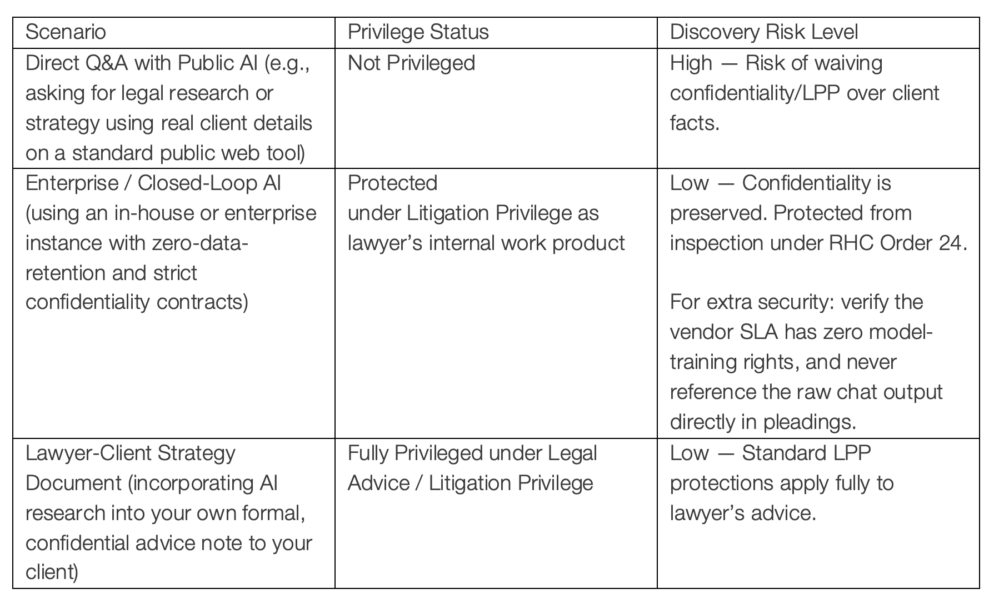
Finally, this is our WATCHOUT! Now that you are happily chatting away to your new AI junior legal assistant, be careful what you chat about, as this could be used against you in a court of law.
Chris Marks, Senior Managing Director, APAC Leader for Legal Technology and Data Analytics for Ankura, and frequent digital forensic partner to bowers.law reminds us that though you may be getting legal advice from your AI, this is not covered by lawyer-client privilege, meaning that your whole conversation can be viewed as part of discovery.
“Generative AI is creating a new and potentially rich source of digital evidence. The prompts and conversations users have with AI tools can reveal intentions, assumptions and decision-making in ways traditional documents may not. As a result, AI interactions are likely to become a routine target of discovery requests, while claims of privilege over those exchanges may face significant challenges. In that sense, generative AI could usher in a new era of ‘smoking gun’ digital evidence.”
Unlike internet search histories which are a lot harder to get a judge to sign-off on, an AI chat is much easier to identify for potential relevance since it’s headlined by the discussion topic. With just one click an entire conversation can expose context, criminal/dishonest intent, strategies for a legal workaround, how to cover your tracks etc., and this can all fall within disclosable material. For forensic investigators following breadcrumbs, this is a full picnic!
In landmark rulings, such as United States v. Heppner (2026)4 U.S. Federal Court judges ruled that inputting sensitive or legal information into a public-facing AI platform (like ChatGPT or Claude) destroys any expectation of confidentiality and automatically waives privilege.
Furthermore, using generative AI – particularly to assess legal exposure before instructing a lawyer – is not covered by work-product doctrine because AI is not legal counsel, nor was it at counsel’s directive.
This also applies to lawyers. Although this remains legally untried in Hong Kong, The Law Society of Hong Kong advises law firms to:
- Remove all confidential client data from prompts unless using enterprise, in
house tools with strict contractual confidentiality. - Audit vendor Terms of Service to verify data retention policies.
- Ensure chat logs are not saved longer than necessary and regularly purge AI histories.
Key Takeaways for Defence Strategy
Remember:
If you’re a client looking for legal advice, your general purpose AI is not a reliable source of legal advice for HK, nor is it covered by legal professional or other privilege. Always engage a certified/qualified lawyer and check that your searches are protected under work-product doctrine.
Also, be aware: When your lawyer writes to you DO NOT UPLOAD IT TO AI FOR A QUICK SUMMARY.
This waives confidentiality and may well forfeit lawyer-client privilege!
If you’re a lawyer, don’t enter any identifying confidential information into a general purpose AI as this is considered public. Check the confidential parameters of your closed-loop system and maintain a solid source trail to double check for ghost authorities. If unsure, always refer to the latest Law Society of Hong Kong directives.
We hope you have found this helpful.
As always, if you suddenly find yourself upstream without a legal paddle – you will at least know where to find us!
- https://bit.ly/48v1jj7
- The Interpretation and General Clauses Ordinance (Cap. 1)
- https://www.aileadership.com/book/
- https://harvardlawreview.org/blog/2026/03/united-states-v-heppner/
Please contact Kevin at kevin.bowers@bowers.law if you have any questions about this Room 228 Newsletter.
…………………………………………………………………………………………………………………………………
This Newsletter is not intended to be and should not be relied on as legal advice. You should seek professional legal advice before taking any action in relation to the subject-matter of this Newsletter.
